Exercise is one of the most powerful tools for keeping your senior large breed dog healthy — but the wrong kind, or the wrong amount, can cause real harm. The challenge for large breed owners is finding the right balance: enough movement to maintain muscle and joint health, without overloading an aging body.
In this guide, we cover exactly how much exercise your senior large breed dog needs, which types are beneficial, which to avoid, and how to adapt as their mobility changes.
Why Exercise Matters More as Dogs Age
Counter-intuitively, exercise becomes more important — not less — as large breed dogs enter their senior years. Here's why:
Muscle loss is the hidden threat. From age 7–8, large breed dogs begin losing muscle mass faster than they rebuild it — a process called sarcopenia. Less muscle means less support around joints, which means more pain, faster joint deterioration, and greater injury risk. Consistent exercise is the only way to slow this process.
Joint health depends on movement. Cartilage receives nutrition through the compression and release of movement — joints that stop moving deteriorate faster. Furthermore, controlled low-impact exercise maintains the synovial fluid that lubricates joints and reduces friction.
Weight management requires activity. A senior dog who stops exercising but continues eating the same amount will gain weight — which directly accelerates joint disease and shortens lifespan.
Mental health. Senior dogs who stop exercising often become anxious, restless, or depressed. Daily movement provides mental stimulation and emotional regulation that significantly improves quality of life.
How Much Exercise Does a Senior Large Breed Dog Need?
There's no single answer — it depends on your dog's age, breed, current health, and fitness level. However, these are reliable guidelines for most senior large breed dogs:
| Age | Daily Exercise |
|---|---|
| 7–9 years | 30–60 minutes, moderate intensity |
| 9–11 years | 20–40 minutes, low-to-moderate intensity |
| 11+ years | 15–30 minutes, low intensity, multiple short sessions |
The key principle: Multiple shorter sessions throughout the day are better than one long session. A 15-minute walk in the morning and 15-minute walk in the evening is better than 30 minutes at once — it avoids fatigue while maintaining joint mobility throughout the day.
Watch your dog, not the clock. The numbers above are starting points. A fit 9-year-old Labrador may comfortably handle 60 minutes. A 7-year-old German Shepherd with hip dysplasia may manage only 20 minutes. Adjust based on how your dog looks and feels after each session.
Signs You're Doing Too Much
Senior dogs often don't self-regulate well — they push through pain to keep up with their owner. Learn to recognize these signs that a session was too intense or too long:
- Limping during or after exercise
- Stiffness the following morning (worse than usual)
- Reluctance to start the next day's walk
- Excessive panting during activity
- Lying down and refusing to continue mid-walk
- Swollen joints after exercise
If you observe any of these, reduce duration and intensity immediately and give your dog a rest day. Furthermore, if limping persists for more than 24 hours, consult your vet.
Signs You're Not Doing Enough
Too little exercise has its own warning signs:
- Significant weight gain over weeks
- Muscle wasting (back legs look thin)
- Restlessness or pacing at home
- Increased stiffness that doesn't improve with gentle movement
- Behavioral changes — irritability, anxiety, destructive behavior
Best Types of Exercise for Senior Large Breed Dogs
1. Leash Walking — The Foundation
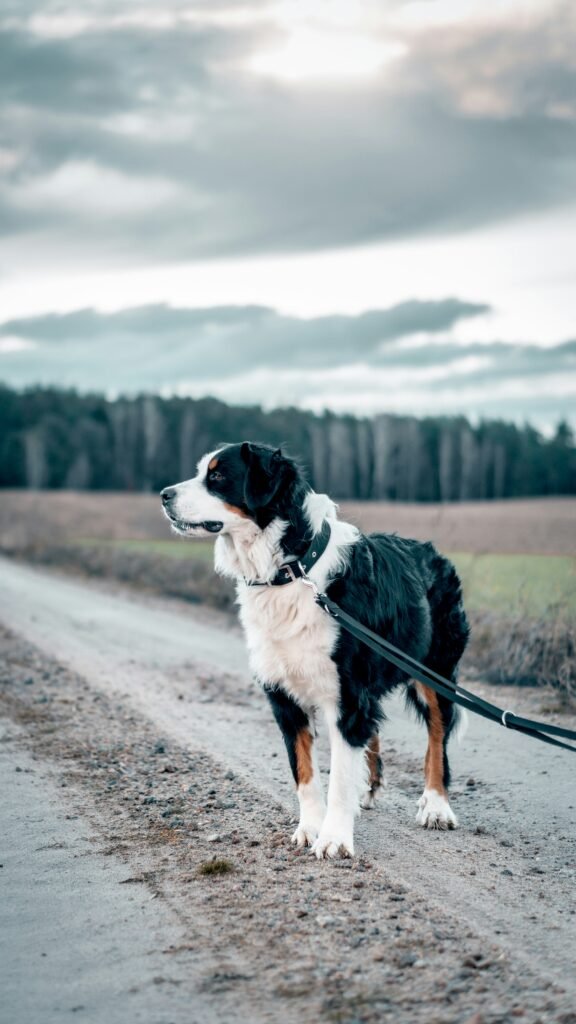
Controlled leash walking is the best daily exercise for most senior large breed dogs. It's low-impact, easily adjustable in intensity, and provides mental stimulation (new smells, environments). In addition, it keeps movement consistent without the risk of sudden acceleration or sharp turns that off-leash running involves.
Tips for senior large breed dogs:
- Walk on soft surfaces when possible (grass, dirt paths > concrete)
- Keep pace slow to moderate — the goal is consistent movement, not cardiovascular exertion
- Avoid steep hills or stairs when possible — flat terrain reduces joint load
- Use a harness instead of a collar — it distributes leash pressure across the chest, not the neck
Read our guide: Best Dog Harnesses for Senior Large Breed Dogs.
2. Swimming and Hydrotherapy — Best for Joint Disease
Swimming is the single best exercise for senior large breed dogs with arthritis, hip dysplasia, or significant joint disease. The buoyancy of water eliminates impact on joints while allowing a full range of motion and cardiovascular exertion. As a result, dogs who can no longer walk comfortably on land often swim with minimal discomfort.
Options:
- Natural lakes, rivers, or beaches (ensure safe footing getting in and out)
- Canine hydrotherapy pools (vet-supervised, often used in rehabilitation)
- Home paddling pools in warm weather for water engagement
Not all dogs swim naturally — introduce water gradually and never force it. However, most large breed dogs who enjoy water can safely swim throughout their senior years.
3. Controlled Fetch — Short Sessions Only
For dogs who are still motivated by fetch, short sessions (5–10 throws maximum) provide excellent mental stimulation and moderate exercise. However, limit hard surfaces, abrupt stops, and high jumps — these all create significant joint impact.
Use soft surfaces, short throws at ground level, and stop before your dog is tired. Furthermore, avoid fetch entirely for dogs with significant hip dysplasia or active joint inflammation.
4. Sniff Walks — Mental Exercise Counts
A "sniff walk" — allowing your dog to stop and smell everything at their own pace — provides significant mental stimulation without physical exertion. Mental exercise is physically tiring in a positive way, and sniff walks are particularly valuable for senior dogs on restricted exercise.
These are not "lazy" walks — they're a deliberate, beneficial activity that addresses cognitive and sensory needs.
5. Gentle Play Sessions
Short indoor play sessions — gentle tug, hiding treats, basic training commands — maintain mental engagement and light physical activity on days when outdoor exercise isn't possible or appropriate.
Exercises to Avoid for Senior Large Breed Dogs
High-Impact Activities
- Off-leash running — uncontrolled acceleration and direction changes create high joint impact
- Jumping — landing from any height creates significant shock through hip and elbow joints
- Frisbee — requires jumping and sudden direction changes
- Dog parks — social benefits aside, uncontrolled play with other dogs creates unpredictable high-impact movements
Forced Exercise
Never force a senior dog to continue when they show signs of fatigue or pain. If they stop and lie down mid-walk, let them rest or carry/support them home. Pushing through pain causes injury and erodes trust.
Exercise in Extreme Heat
Large breed dogs are vulnerable to heat stroke, and senior dogs are more sensitive than young dogs. Avoid exercise when temperature exceeds 25°C (77°F), walk during cooler hours (early morning or evening), and always carry water.
How to Adapt Exercise as Mobility Declines
As your senior dog's mobility decreases, adapt the exercise rather than eliminating it:
Mild mobility loss:
- Reduce walk distance by 20–30%
- Add a second shorter walk instead of one longer one
- Switch from concrete to grass surfaces
- Use a harness for better control
Moderate mobility loss:
- Focus on slow sniff walks of 10–15 minutes
- Add hydrotherapy if accessible
- Use a rear support harness for assistance on inclines
- Consult your vet about pain management to keep exercise comfortable
Significant mobility loss:
- Passive range-of-motion exercises (gentle joint flexion/extension while dog lies down)
- Very short leash walks for bathroom and stimulation
- Hydrotherapy with vet guidance
- Physical therapy with a canine rehabilitation specialist
Read our guides: Best Dog Ramps for Senior Large Breed Dogs and Best Dog Harnesses for Senior Large Breed Dogs.
The Role of Joint Supplements in Maintaining Exercise Capacity
Dogs on joint supplements (glucosamine, chondroitin, omega-3 fatty acids) consistently maintain better mobility and exercise tolerance than unsupplemented dogs. Starting supplementation at age 5–6 — before significant joint damage — produces the best long-term results.
Read our guide: Best Joint Supplements for Senior Large Breed Dogs.
Frequently Asked Questions
How much exercise does a senior large breed dog need per day? Most senior large breed dogs (7–9 years) benefit from 30–60 minutes of exercise per day, split into two sessions. Dogs 9+ years generally do better with 20–40 minutes of gentle activity. The key is consistency and watching your dog's response.
What is the best exercise for a large breed dog with arthritis? Swimming and hydrotherapy are the best exercises for arthritic dogs — full range of motion with zero joint impact. Slow leash walking on soft surfaces is the best land-based option. High-impact activities (jumping, running on hard surfaces) should be avoided.
Should I exercise my senior dog even if they seem reluctant? Yes — gently. Reluctance to start a walk often reflects morning stiffness rather than unwillingness to exercise. A slow 5-minute warm-up often resolves it. However, if reluctance is consistent or accompanied by limping, a vet visit is needed to assess pain levels.
Can exercise help with hip dysplasia in large breed dogs? Yes. Controlled low-impact exercise (walking, swimming) maintains the muscle mass that supports the hip joint, which reduces pain and slows deterioration. In addition, it helps maintain healthy weight — the single most important factor in managing hip dysplasia.
How do I know if I'm exercising my senior dog the right amount? A well-exercised senior dog should be pleasantly tired after walks, sleep soundly, and wake up without significant stiffness. If they're limping after walks or significantly stiffer the next morning, reduce intensity. If they're restless, gaining weight, or losing muscle, increase gentle activity.
Summary
Exercise is not optional for senior large breed dogs — it's essential medicine. The goal shifts from performance to maintenance: keeping muscles strong, joints mobile, weight healthy, and mind engaged.
Consistency matters more than intensity. A dog who walks 20 gentle minutes twice daily will age far better than one who rests all week and over-exerts on weekends.
Start where your dog is, watch how they respond, and adjust. The best exercise program is the one that keeps them moving comfortably for as long as possible.